Skip to content
  English
  Spanish
If you run a food production line, a butcher shop, a commissary kitchen, or a manufacturing unit that ships sensitive goods, you have almost certainly asked how to keep products fresh, safe, and presentable for longer. A vacuum packaging machine is one of the most practical answers. In this guide, you will learn what it is, how it works step by step, the main types available, the benefits it brings to your business, what you can package with it, and — most importantly — how to choose the right model for your output and budget. We also cover the commercial vacuum sealer options buyers compare most often and answer the questions procurement teams ask before they buy.
What Is a Vacuum Packaging Machine?
One-Line Definition
A vacuum packaging machine is a piece of food and industrial vacuum packaging equipment that removes air from a package — usually a plastic pouch or a rigid tray — and seals it shut to create a near-oxygen-free environment. By taking the air out before the seal, the machine protects the product from the two things that spoil it fastest: oxygen and the microbes carried in trapped air.

Core Parts
Whether you look at a small tabletop unit or a fully automatic line, most machines share the same building blocks. Knowing them helps you read a spec sheet and compare models honestly.
| Part | What It Does |
|---|---|
| Vacuum chamber / sealing area | Holds the bag or tray and contains the vacuum for chamber and skin machines. |
| Vacuum pump | Draws air out of the chamber or bag, creating the low-pressure environment. |
| Sealing bar & heating element | Heats and fuses the bag film (or lidding film) to form an airtight seal. |
| Control panel / PLC | Sets vacuum time, seal time, and gas-flush ratios; stores programs for repeat runs. |
| Gas-flush port (MAP) | Optional line that introduces a nitrogen / CO₂ mix after vacuuming for modified atmosphere packs. |
| Solenoid valve | Controls air routing between pump, chamber, and vent; on in-house patented designs this improves consistency. |
The Single Problem It Solves — Oxidation & Microbial Growth Caused by Trapped Air
Most spoilage starts with the air you cannot see. Oxygen drives oxidation — rancidity in fats, browning in cut produce, colour loss in fresh meat, and the slow breakdown of vitamins. At the same time, the aerobic bacteria and moulds that cause rot need that same oxygen to multiply. A vacuum packaging machine attacks the root cause by pulling air out before the seal, so your product sits in a low-oxygen pocket instead of a stale one.
One accurate caveat your food-safety team should keep: vacuum packing slows aerobic spoilage, it does not sterilise. It does not kill bacteria, and some anaerobic pathogens (such as Clostridium botulinum) actually prefer low-oxygen environments — which is exactly why chilled storage and correct handling remain non-negotiable for vacuum-packed foods.
How Does a Vacuum Packaging Machine Work? (Step by Step)
The principle is simple; the engineering is what separates a reliable unit from a frustrating one. Here is the cycle you can expect on a typical chamber machine:
- Load the product. You place the item in a bag (or on a tray) and lay it on the sealing area or inside the chamber.
- Close the lid. On a chamber model the lid locks and the space is sealed; on an external (snorkel) model you position the nozzle over the bag opening.
- Evacuate the air. The vacuum pump extracts air, dropping chamber pressure — good chamber machines reach roughly 1–2 mbar.
- Optional gas flush. If you run MAP, a controlled mix of nitrogen and CO₂ is introduced to protect colour and flavour.
- Seal. The sealing bar heats and fuses the film, creating an airtight seam.
- Vent and release. The chamber re-pressurises, the seal cools and sets, and you remove a finished pack.
What Are the Types of Vacuum Packaging Machines?
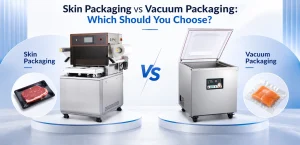
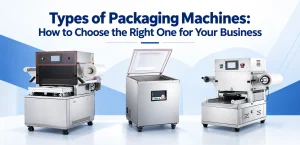
Machines are grouped by how they hold the product during evacuation. The right family depends on your pack size, throughput, and whether you also need skin or MAP presentation — for retail-ready tray packs, a vacuum skin packaging machine is the format buyers usually mean.
Tabletop Single / Double Sealer
A compact chamber unit that sits on a counter. Single-chamber versions seal one side; double-sealer versions give you two sealing bars for wider bags. Best for delis, cafés, labs, and low-volume lines where space is tight and you pack a few dozen pouches a day.
Floor-Standing Chamber
A larger chamber on a cabinet, with a bigger pump and wider seal bars. This is the workhorse for butcher shops and mid-size food lines that need consistent seals on bigger cuts and higher daily counts.
Double-Chamber
Two chambers let your operator load one side while the other evacuates — so the pump never stops. An industrial vacuum packaging machine in this class is the default for high-volume meat, seafood, and cheese processors.

External (Snorkel) Type
No chamber — a snorkel nozzle sucks air straight out of the bag. That makes it ideal for bulky or awkwardly shaped products (pillows, large bags, non-food items) that would never fit a chamber. Throughput is lower, but the format is flexible.
Automatic Rolling / Continuous
A belt-fed chamber that moves packs through continuously for inline production. This is the automatic vacuum packaging machine class for factories running 20–60+ bags per minute, often paired with MAP and upstream tray lines.
| Machine Type | Chamber Style | Best For | Typical Output |
|---|---|---|---|
| Tabletop single / double | Chamber (small) | Cafés, delis, labs, low volume | 2–8 bags / min |
| Floor-standing chamber | Chamber (large) | Butcher shops, mid food lines | 4–10 bags / min |
| Double-chamber | Chamber (two) | High-volume meat / seafood | 8–20 bags / min |
| External (snorkel) | No chamber (snorkel) | Bulky / large bags, pillows | 2–6 cycles / min |
| Automatic rolling | Belt-fed chamber | Industrial lines | 20–60 bags / min |
Why Use a Vacuum Packaging Machine? (Benefits)
When your business packages food or sensitive goods, the return on a commercial vacuum sealer shows up in several places at once:
- Longer shelf life. Removing oxygen slows spoilage, so products stay saleable for days or weeks longer.
- Less waste. Fewer rejects and markdowns mean a direct hit to your bottom line, not the bin.
- Freezer-burn protection. Airtight packs keep frozen goods from drying out and tasting stale.
- Lower logistics cost. Smaller, tighter packs ship and store more densely than rigid containers.
- Hygiene & tamper evidence. A sealed pouch is clean and obvious if opened.
- Better presentation. Especially with skin and MAP, the pack itself becomes part of the sell.
| Browse DJPACK’s full vacuum packaging machine range From tabletop sealers to automatic lines, compare chamber sizes, pumps, and throughput to match your production volume. |
What Can a Vacuum Packaging Machine Package
A food vacuum packaging machine is only the start — the same vacuum principle protects many non-food goods too:
- Fresh meat & poultry — the classic use case, where colour and shelf life matter most.
- Seafood & deli — fish, cheese, and cured meats hold up far longer when oxygen is gone.
- Coffee, nuts & grains — oxygen is what flattens aroma and turns oils rancid.
- Prepared & ready meals — MAP and skin formats keep them retail-ready.
- Medical & electronics — non-food lines use vacuum packs against moisture and dust.
- Textiles & hardware — compact, protected packs for storage and export.
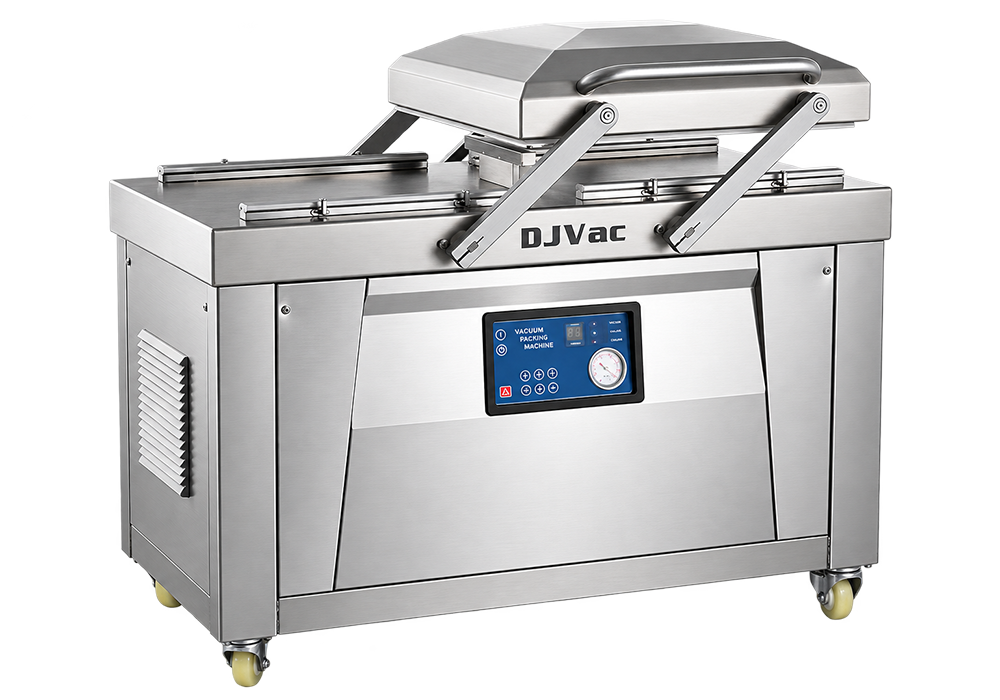
How to Choose the Right Vacuum Packaging Machine (5 Factors)
The “best” machine is the one matched to your real daily load, not the one with the longest spec sheet. Weigh these five factors before you request a quote:
Output Volume & Speed
Count packs per hour at peak, not average. A tabletop sealer covers a few dozen a day; a double-chamber or automatic line covers hundreds to thousands. Buy for your worst week, not your quiet Tuesday.
Product Size & Chamber Dimensions
Measure your largest pack. If a whole brisket or a bulky pillow will not fit the chamber, you need a bigger chamber or an external snorkel type.
Food Type — Liquids & Moisture
Wet or liquid products can be pulled into the pump. Look for liquid blocks, sensor-controlled evacuation, or chamber tilt so your vacuum sealer machine handles soups, marinades, and fresh cuts cleanly.
Gas Flushing / MAP Need
If colour and aroma must survive (fresh meat, coffee, cheese), you will want a gas-flush port or a dedicated modified atmosphere packaging (MAP) machine.
Build Quality & Certifications
For food use, insist on 304-grade stainless steel in the chamber and shell, and verify CE and ISO certification from the manufacturer. Established OEMs such as DJPACK (Wenzhou Dajiang, making vacuum packaging machines since 1995) build to these standards.
Quick Machine Selector
Use this decision guide to narrow your shortlist before you talk to a supplier.
| Your Situation | Recommended Starting Point |
|---|---|
| Under ~50 packs / day, tight counter space | Tabletop chamber sealer |
| 50–300 packs / day, mixed sizes | Floor-standing chamber |
| 300+ packs / day, meat or seafood | Double-chamber or automatic line |
| Large pillows / bulk that will not fit a chamber | External snorkel type |
| Retail-ready skin presentation on trays | Vacuum skin packaging machine |
| Not sure which model fits your line? Send us your pack size, daily volume, and product type — our engineering team will shortlist the right chamber, pump, and seal configuration for your business. |
FAQs
What is the difference between a vacuum sealer and a vacuum packaging machine?
They are the same category — “vacuum sealer” is the consumer-friendly name and “vacuum packaging machine” is the industrial one. A household vacuum sealer machine seals edge bags; a commercial or industrial vacuum packaging machine adds a chamber, a stronger pump, gas flushing, and the duty cycle to run all day. When you buy for a business, shop by chamber size, pump capacity, and certifications rather than the label.
How much longer does vacuum packaging keep food fresh?
It depends on the product and storage, but as a rule of thumb refrigerated vacuum-packed fresh meat lasts roughly 2–4× longer than loose storage, and frozen goods avoid freezer burn for many months. MAP and skin formats can extend that further for retail. Always pair vacuum packing with correct chilled storage — it slows spoilage, it does not replace refrigeration.
Can a vacuum packaging machine seal liquids and moist foods?
Yes, with the right configuration. For soups, marinades, and fresh cuts, choose a chamber machine with a liquid block, sensor-controlled evacuation, or tilt function so liquid is not pulled into the pump. External snorkel types also handle moist and bulky items well.
What chamber size does my business need?
Size the chamber to your largest single pack plus clearance for the seal bar. If your biggest item fits only awkwardly, you will slow every cycle. Measure the product, add the bag, and confirm the chamber interior — not just the footprint — before you commit.
Is a commercial vacuum sealer worth it for a small food business?
For most small food businesses it pays back through less waste, longer shelf life, and the ability to sell pre-packed portions. A tabletop or floor-standing chamber is a modest outlay that often recovers its cost in reduced spoilage within a season — especially if you sell meat, cheese, coffee, or prepared meals.
What is the difference between vacuum packaging and modified atmosphere packaging (MAP)?
Vacuum packaging removes the air; MAP removes it and then replaces it with a tailored gas mix (usually nitrogen and CO₂) to protect colour and aroma. MAP needs a gas-flush port or a dedicated modified atmosphere packaging (MAP) machine. Many buyers start with vacuum and add MAP when retail presentation matters.
Conclusion
A vacuum packaging machine solves one core problem — the air that spoils your product — and it does so across food and non-food lines alike. You now know what it is, how the cycle works, which type fits which job, the benefits it brings your business, and the five factors that should drive your purchase. Match the machine to your real daily volume and product, insist on food-grade build and certifications, and you will protect shelf life, cut waste, and present a better pack to every customer.